Cutting the Bill in Half
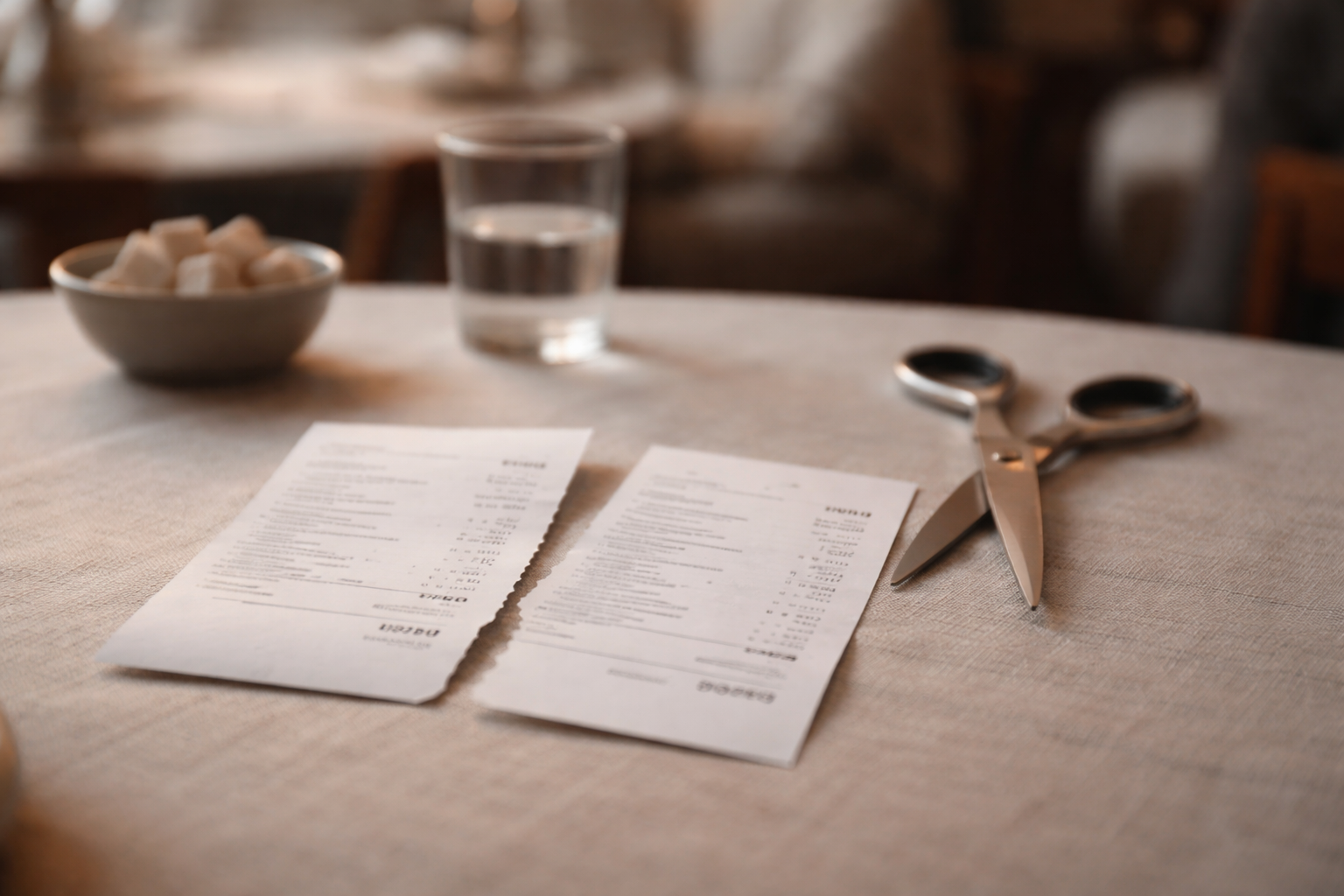
The server doesn’t arrive with a dessert menu. He arrives with a grin and a raised hand. Rock, paper, scissors. Win, and you cut the bill in half.
It’s explained clearly and without theatre, then repeated across the room with identical energy. No awkward upsell tone, no muttered small print. Just a quick countdown, hands revealed, laughter or mock despair depending on the outcome. Phones appear. Someone records it. The moment travels beyond the table.
Operator intent
January is structurally difficult for independent hospitality. Footfall drops and average spend tightens, so discounting becomes the familiar lever. The likely intention here is commercially sound: drive volume without eroding brand warmth, create a reason to visit that feels generous but not desperate, and protect margin where possible.
A straight 50 percent discount for all would guarantee traffic but at a fixed cost. This mechanic reframes the same headline saving into a game where some guests win and some do not, meaning the restaurant’s maximum exposure is capped while the emotional upside remains open-ended.
There is also something more subtle at play. The offer isn’t hidden in small print or triggered by a guest request. It’s initiated confidently by the team, which removes friction and makes the promotion feel embedded rather than bolted on.
The system beneath it
This only works because it’s systemised. Every server understands the rules, the timing is consistent, the explanation is tight, and the tone is playful but controlled. There’s no visible negotiation and no deviation between tables, which prevents awkwardness and protects pace of service.
What appears spontaneous is in fact carefully defined. The team has been trained not just on the words but on the energy, including when to introduce it, how to close it, and how to react whether the guest wins or loses. That shared script keeps the room aligned and the interaction light rather than chaotic.
Crucially, the mechanic replaces a percentage sign with a behaviour. Instead of reading 50 percent off on a window, guests participate in a moment that briefly interrupts the standard payment ritual and makes the discount experiential rather than transactional.
The pattern
Most independent operators default to static discounting when trade softens. A chalkboard outside or a social post announces a deal, but the underlying system remains unchanged and only the price moves. Over time, this trains guests to wait for offers and subtly recalibrates pricing tolerance downward.
Here, the structural pattern is different. The usual January lever is margin sacrifice; this lever is engagement, which generates story value alongside financial protection. Stories travel further than percentages.
Commercial consequence
At a basic level, the expected discount rate sits below 50 percent. If outcomes are evenly distributed, the effective reduction trends towards roughly 25 percent across the room, immediately protecting contribution per cover compared to a universal half-price model.
The more interesting levers sit elsewhere. Dwell time extends slightly as tables watch neighbouring games unfold, reorder frequency may lift because the environment feels lighter and more celebratory, and word of mouth accelerates because the interaction contains a clear narrative beat that is easy to retell.
There’s also a pricing tolerance effect. Because not everyone wins, the full menu price remains psychologically intact and the reference price is not permanently reset, which protects the perceived value of the core offer beyond January.
None of this happens accidentally. It depends on consistent execution, because if one server forgets to offer it or frames it apologetically, the system fractures and perceived fairness erodes. Defined play is what keeps the experience warm but controlled.
The principle
Defined play outperforms undefined discounting.
The reset
First, convert one static promotion into a behaviour guests physically participate in rather than passively receive.
Second, script the interaction tightly and rehearse it so delivery feels confident and identical across every table.
Third, measure the effective discount rate and compare it to a flat offer to understand the true margin impact.